Horseshoe Kidney Inferior Mesenteric Artery

Figure 2 From Horseshoe Kidney A Case Report Semantic Scholar
Https Www Birpublications Org Doi Pdf 10 1259 Bjr 20140456

A Horseshoe Kidney With Partial Duplex Systems

Renal Fusion And Ectopia Abdominal Key

Arterial And Venous Pattern Of Horseshoe Kidney Showing Abdominal Aorta Download Scientific Diagram
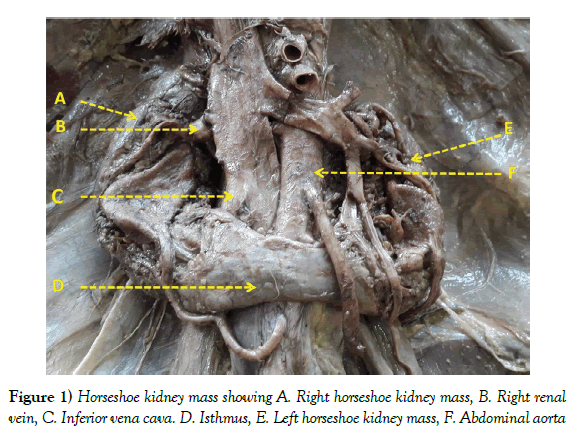
A Study Of Horseshoe Kidney A Rare Anatomical Variant
Mesenteric artery turner syndrome inferior mesenteric artery pole variant horseshoe kidney these keywords were added by machine and not by the authors.
Horseshoe kidney inferior mesenteric artery. Enhanced axial ct scan of abdomen at two near contiguous levels shows a horseshoe shaped kidney blue arrows which has functioning. The main renal artery a branch from the abdominal aorta originating above or below the isthmus the common iliac artery or the inferior mesenteric artery. Horseshoe kidney is the most common type of fusion anomaly with an incidence of 0 15 in the general population fig. Considering the embryological aspect the isthmus blood supply reflects vascular changes of the developing kidneys during the course of kidney ascent from.
Its ascension may also be restricted by its own renal artery. The incidence of renal vein anomalies in horseshoe kidneys is also high 23. However complications can occur from the poor drainage of the kidney such as hydronephrosis renal stones and infection. Isthmus is anterior to aorta and inferior vena cava and posterior to inferior mesenteric artery.
The ureters leave the kidneys and pass anterior to the isthmus which is typically located immediately below the inferior mesenteric artery. The isthmus may receive its blood supply from. Hence horseshoe kidneys are low lying. Half of patients with a horseshoe kidney have renal complications or associated.
It does not require any treatment and is often asymptomatic. Receive blood from the main renal artery from the abdomi nal aorta originating above or below the isthmus the common iliac artery or the inferior mesenteric artery mano et al 2016. In human anatomy the inferior mesenteric artery often abbreviated as ima is the third main branch of the abdominal aorta and arises at the level of l3 supplying the large intestine from the distal transverse colon to the upper part of the anal canal. In patients with this condition the horseshoe kidney ascent is commonly arrested by the inferior mesenteric artery due to the central fusion of the kidneys.
In a patient with horseshoe kidney the fused kidney becomes hooked underneath the inferior mesenteric artery and is stuck in the lower abdomen. As a result of this fusion the inferior pole of each kidney point medially which is the reverse of the normal renal axis. This process is experimental and the keywords may be updated as the learning algorithm improves. However this is present in only 40 of cases and in 20 of cases the fused kidney remains in the pelvis.
While up to 42 72 n 162 of renal arteries for horseshoe kidneys branched off the aorta or iliac artery below the origin of the inferior mesenteric artery this topographic pattern was followed by less than 1 n 2 of the renal arteries supplying separated kidneys.
